Rehab Cost Customization
Last updated: June 4, 2026
💰 Know What It Costs — Before You Break Ground
Prioritizing pipes by risk is only half the battle. The other half is answering the question every stakeholder asks next: "What do I need to fix and what’s it going to cost?”
With our new Rehab Cost Customization tools, PIONEER generates consistent, explainable cost estimates automatically alongside every Rehab Recommendation, so your team can plan budgets, justify decisions, and move forward with confidence.
💡 Why This Matters
Estimating rehab, repair, and even maintenance costs used to mean complex formulas, manual calculations, and lots of engineer time. It also meant tedious adjustments from year to year or project to project. Justification became complex.
The PIONEER Rehab Cost Customizer changes that. Our foundational calculations are built on a structured model based on hundreds of real bid tabulations from municipalities across the United States. Out of the box, every Risk Recommendation now comes with a defensible, repeatable cost estimate, one your team can stand behind.
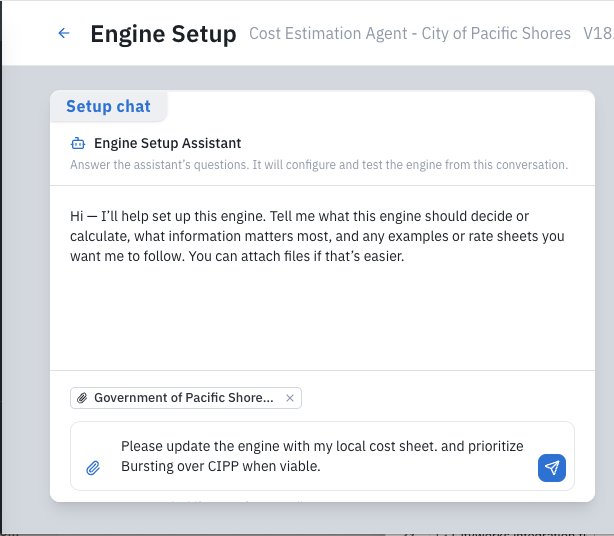
By simply attaching your latest cost table or a few sentences to our helpful agent, you can adjust the cost calculation to match your local reality. Tweak and save cost variations across projects, clients, or regions with unlimited iterations.
Whether you're a utility engineer building a capital plan or an engineering firm preparing for a project, you'll have cost estimates grounded in real methodology, not guesswork.
🔧 What This Unlocks
Automatic cost estimates are generated for every asset and every Rehab Recommendation, no manual entry required.
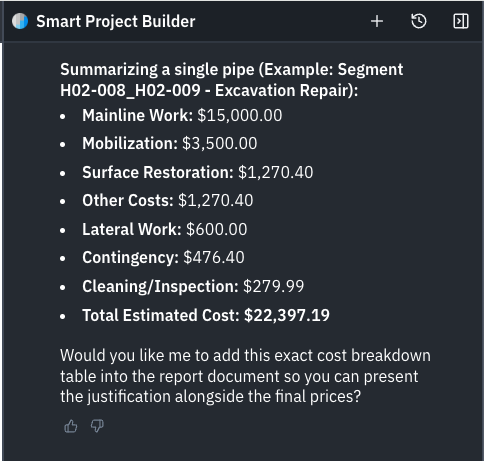
Consistent, reliable calculations that account for the type of repair or rehab recommended, the size and condition of the pipe, mobilization, and project-scale factors like economies of scale and contingencies.
our pricing, your way, when you attach your own bid tabs or cost data to tailor estimates to your local market and contractor rates. The more context you provide, the sharper your estimates get.
Cost visibility across PIONEER estimates appears on the Risk Table, in each asset's detail view, in Work Plans, and feeds directly into Smart Project Builder for project-level budgeting.
Reach out to your account team to attach a custom cost sheet and see estimates calibrated to your region.
🔍 How Costs Are Calculated
The engine considers several key factors when building an estimate for each asset:
Repair or rehab approach — the biggest driver of cost. The recommended fix, whether it's Trenchless lining (CIPP), pipe bursting, or a point repair, shapes what the work will require and what it will cost.
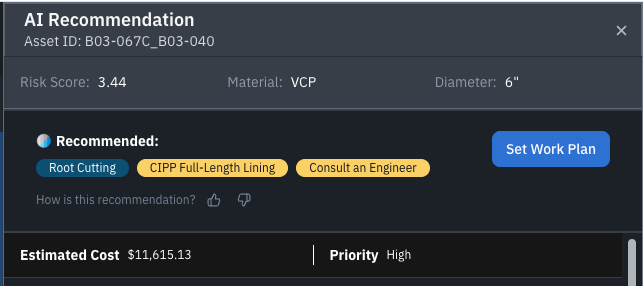
Pipe characteristics — size, depth, condition severity, and the specific defects identified all play a role in determining the scope and cost of work.
Location and market conditions — estimates are adjusted for regional labor and market rates, and can be further refined using your own contractor pricing.
This isn't a single flat number per recommendation. It's a calculation built from the actual work being suggested, grounded in how that work is typically priced in your area.
🛠 Getting Started
Upload your pipe map layer into PIONEER - for any lines with inspections, Rehab Recommendations, and cost estimates run automatically from there.
Review cost estimates aligned to each Recommendation by clicking into an asset.
Explore and Ask Questions about rehabbing pipes and creating work orders inside the Smart Project Builder.
Customize (optional) — work with your SewerAI team to attach your own cost sheet or bid tab. Re-run the engine to see estimates tuned to your region and rates. Your inputs help the system get more accurate over time.
📌 What to Keep in Mind
Cost Engine outputs are planning-level estimates built to be directionally reliable for budgeting and prioritization, not a replacement for final bid pricing. Think of them as a defensible starting point that helps your team move faster and plan smarter.
Accuracy improves with local context. If you have historical bid data or regional pricing, sharing it with your SewerAI team will bring estimates closer to what you'll actually spend in the field. You can also adjust assumptions and correct estimates as you validate them against real projects, and those corrections help the model improve over time.